

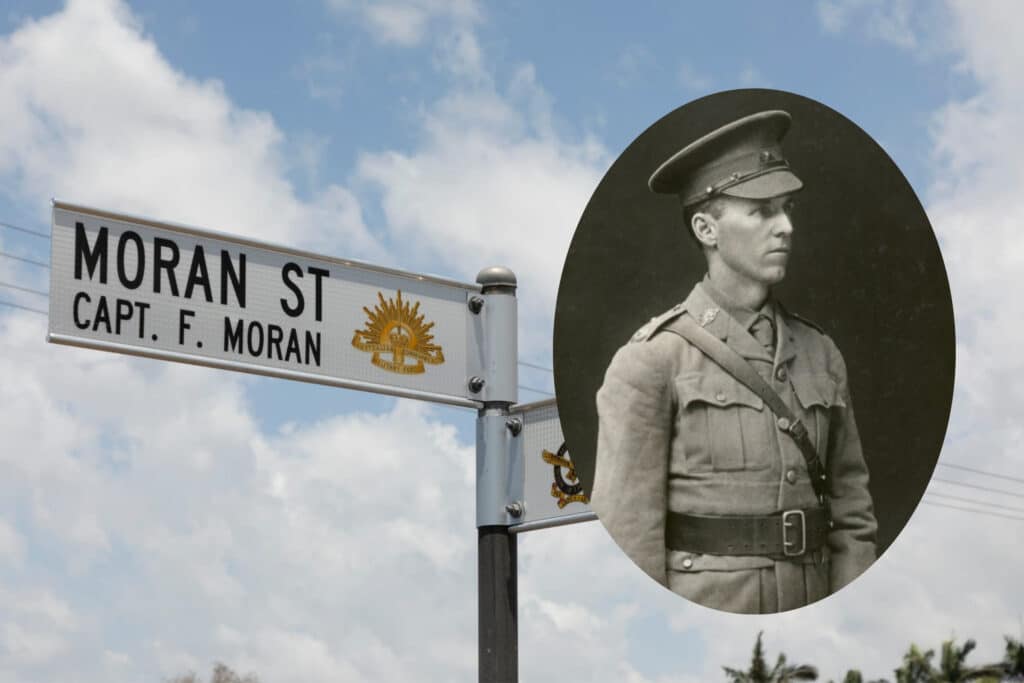
A World War I army captain and Gallipoli hero with links to the Bundaberg Region has been remembered on the Svensson Heights street named in his honour.
Captain Francis (Frank) Moran’s name and the Rising Sun badge of the Australian Army have been added to Moran Street signage as part of Bundaberg Regional Council’s Streets of Remembrance program.
Frank was born on 27 June 1877 in Springsure, Queensland to Dr Charles Moran and Ellen Moran, and was privately educated as a child.
In 1901, following the Federation of Australia, Frank joined the newly formed Commonwealth Military Forces as a Lieutenant in the Australian Infantry.
He then became a Lieutenant in the Australian Commonwealth Horse mounted infantry unit in 1902 during the South African War.
After a period working as a blank clerk, Frank continued his involvement in the miliary as Area Officer in Bundaberg from 1911 to 1913 and Area Officer in Brisbane from 1913 to 1914.
Area Officers were responsible for peacetime military training of cadets and home defence militia as part of the compulsory Universal Service Scheme.
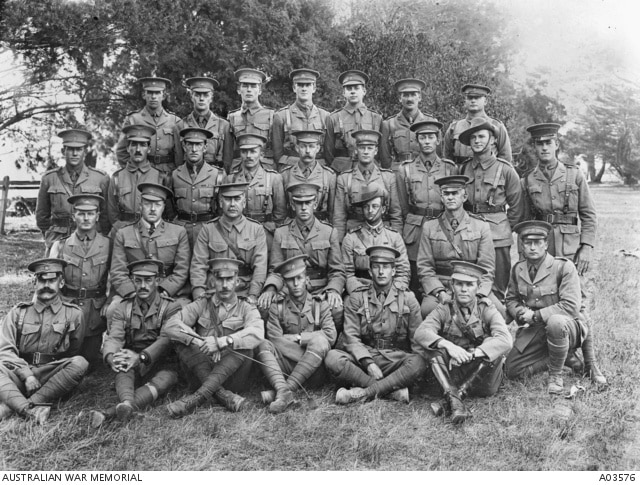
Frank received his commission as an officer in the Australian Expeditionary Force on 23 September 1914, entering as a Lieutenant before being promoted to Captain on 16 December 1914.
He was a member of the 15th Australian Infantry Battalion of the Australian Imperial Force and embarked overseas from Melbourne onboard HMAT Ceramic A40 in December 1914.
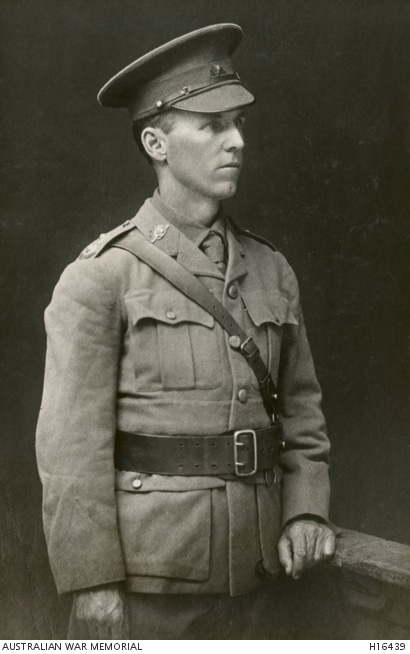
The battalion arrived in Egypt in February 1915 and undertook training in the desert.
At war in Gallipoli
Frank was part of the Allied forces that landed at Gallipoli on 25 April 1915, at the very beginning of the campaign that helped established the reputation of the Anzacs.
He was wounded in action in Gallipoli on 2 May 1915 with a gunshot wound to his thigh but was able to rejoin his battalion on 1 June.
Frank was again wounded in action on 5 August 1915, suffering a gunshot wound to his right shoulder.
According to a Red Cross report from Private J Pitchford of the 15th Battalion, Frank was leading 200 to 300 men at a hill close to Chunuk Bahar when he fell.
Private Pitchford also reported Frank was “an excellent captain, a very brave man”.
Frank was admitted to the hospital ship Valdivia and later transferred to HMHS Aquitania but died of his wounds on 20 August 1915, aged 38 years.
Military honours
Captain Frank Moran was buried at sea near Gallipoli.
He was Mentioned in Despatches for conspicuous services, published in the London Gazette on 25 January 1916.
Following his death, Frank’s mother Ellen received his 1914/15 Star, British War Medal and Victory Medal, along with a Memorial Scroll and Memorial Plaque.
Obituaries for Frank appeared in the Maryborough Chronicle and Brisbane Courier.
Frank is listed on the Australian War Memorial Roll of Honour, the Esk War Memorial and Lone Pine Memorial, Gallipoli Peninsula, Türkiye.
Information about Captain Frank Moran’s life and service is from the National Archives of Australia, Australian War Memorial and Commonwealth War Graves Commission.
Streets of Remembrance
Bundaberg Regional Council’s Streets of Remembrance program recognises the service of veterans with a connection to the Bundaberg Region by adding the badge of the military force in which they served to the street sign of streets named in their honour.
More information about Bundaberg Regional Council’s Streets of Remembrance program and how to nominate a street or service person is available here.