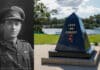

Tomlinson family recognised for wartime service
Ten members of the Tomlinson family have been recognised for their service and sacrifice across two World Wars as part of Bundaberg Regional Council’s Streets of Remembrance program.
Tomlinson Street in East Bundaberg, named for the family in 1940, now bears signage and Australian Defence Force insignia for each family member who served.
Brothers David and Robert Tomlinson and their nephew Cornelius Tomlinson joined the Australian Imperial Force in World War I.
Each saw active service overseas and endured wartime injury and illness before returning to settle in the Bundaberg area.
David’s sons Alex and Percy enlisted for the Australian Army in World War II and were both sent to Singapore, where sadly Percy was killed in action and Alex was taken prisoner of war.
Robert’s sons Harold and Ronald also enlisted for service in World War II, Harold in the Royal Australian Air Force and Ronald in the Australian Army assigned to the Catering Corps.
Cornelius’s daughters Myrtle and Ivy joined the Women’s Auxiliary Air Force for World War II, working at the No.8 Service Flying Training School in Bundaberg.
Their brother Cornelius (the younger) joined the Royal Australian Navy at age 18 and sailed on various vessels operating around New Guinea and the South-West Pacific during World War II.
Colleen Broom, daughter of Cornelius (the elder) lives in Bundaberg and said she was proud to see her family recognised through the program.
“Having a street named after your family is significant in itself, but seeing my father, brother, two sisters and other members of our extended family – ten in total – honoured for their service fills me with pride,” Colleen said.
“Seeing the signs for the first time was a deeply moving experience.
“These signs, near East Bundaberg’s iconic water tower, bring together our family’s local history and the service of our veterans, keeping their names and contributions alive for future generations.”
Colleen’s son Jason Broom researched his family history and provided an account of each veteran’s life and service, below.


Colleen Broom with the street sign honouring her father, sisters and brother. Image: Jason Broom.
Colleen Broom on the corner of Tomlinson Street. Image Jason Broom.
Private David Malcolm Tomlinson
David Malcolm Tomlinson was born at Woongarra on 31 January 1881 and worked as a distiller before WWI and a sawmiller at Skyring's sawmill for many years following his return.
Married to Annie Cooper and living on Alexandra Street, East Bundaberg, he was 35 years old when he stepped forward to enlist — older than many of his comrades — on 13 May 1916 alongside his younger brother Bob.
He joined the 42nd Battalion and embarked from Brisbane aboard the troopship Clan MacGillivray on 7 September 1916, disembarking at Plymouth, England, on 2 November 1916.
After training at Hurdcott and Perham Downs, David proceeded to France in February 1917, joining his battalion in the field.
On 8 June 1917, he was struck by poison gas in France — a weapon that had become one of the most feared on the Western Front.
Despite recovering and returning to his unit, he was gassed again on 8 June 1918.
He transferred between battalions, from the 42nd to the 41st and finally to the 34th Battalion in November 1918, serving through to the Armistice.
David returned to Australia aboard the Borda, disembarking on 27 June 1919, and was awarded the 1914–1915 Star, the British War Medal, and the Victory Medal.
He had served his country with quiet determination, surviving the worst the Western Front could inflict.
Back in Bundaberg, David took a keen interest in the East Bundaberg sporting community, particularly football, and served as a trustee of the East Bundaberg Recreation Reserve.
His wife Annie predeceased him in 1936.
David Malcolm Tomlinson passed away at Bundaberg General Hospital in September 1942.
He died not knowing the fate of two of his sons, Alexander and Percy, both of whom had enlisted with the AIF early in World War II and had been reported missing in Singapore.
The obituary published in the Bundaberg Daily News-Mail on 21 September 1942 recorded simply that "both have since been reported missing in Singapore."
It would be three more years before the truth became known: Muir Percy had been killed in action, and Alexander had survived as a prisoner of war.
David is survived in memory as a man who gave his own years of service in WWI and then watched his two youngest sons march away to war in WWII and died not knowing whether they were alive or dead.
Service Number: 2174
Service Area: Australian Imperial Force – 34th Australian Infantry Battalion
Highest Rank: Private
Years of Service: 13 May 1916 – 27 June 1919
Private Robert Edward Tomlinson
Robert Edward “Bob” Tomlinson was born at Woongarra on 5 January 1884, the younger brother of David, and worked as a sawmiller.
He was married to Jessie Stupart, and they lived at Bridge Street, East Bundaberg.
At 32 years of age, Robert stood alongside his older brother and enlisted on the same day — 13 May 1916 — the two Tomlinson brothers joining the colours together in a demonstration of family loyalty and patriotism that would become a hallmark of this remarkable family.
Robert sailed with David on the Clan MacGillivray, arriving in England in November 1916, and proceeded to France in February 1917 with the 42nd Battalion.
He was wounded in action on 8 April 1917, remaining at duty.
Later that year, on 14 October 1917, he was admitted with Immersion Contact Trench Feet (ICT) — a debilitating condition caused by prolonged exposure to cold and wet — and was invalided to England, admitted to the Auxiliary Hospital at Warrington.
He eventually recovered and attached for duty with the Permanent Cadre of No. 4 Command Depot at Tidworth.
However, Robert was ultimately returned to Australia for discharge on account of deafness, arriving home in July 1918.
He was awarded the British War Medal and the Victory Medal.
Service Number: 2170
Service Area: Australian Imperial Force – 42nd Australian Infantry Battalion
Highest Rank: Private
Years of Service: 13 May 1916 – 12 September 1918
Lance Sergeant Cornelius Tomlinson
Cornelius “Corney” Tomlinson was born in Bundaberg on 15 December 1893, the son of Cornelius Tomlinson and Sarah Ann Puckering.
He was a 21-year-old timber machinist, trained through a five-year apprenticeship following his father’s occupation, when he enlisted at Bundaberg on 17 August 1915 — the youngest of the first Tomlinson generation to go to war.
His next of kin was his father, Cornelius Tomlinson Senior, of Alexandra Street, East Bundaberg.
After training, he embarked from Australia in September 1915 and served in Egypt before transferring to the Western Front with the 9th Battalion.
Cornelius endured one of the most arduous combat records of any member of the family.
He was wounded in action in France on 2 July 1916, and again on 23 July 1916 — suffering a gunshot wound to the buttock — and was evacuated by hospital ship St Andrew to England.
He was admitted to the 3rd Western General Hospital at Newport, Monmouthshire.
His anxious parents sent urgent telegrams to Base Records in Melbourne and even to Senator Pearce, seeking news of their son's condition.
After recovering in England, he was hospitalised again in January 1917 with an ulcer on his heel, requiring treatment at Bethnal Green Military Hospital.
He returned to the front and was wounded a third time on 23 August 1918, this time by gas and shell — classified as "Gassed, classed as wounded, 3rd occasion."
He rejoined his battalion and served through the final advance, and by December 1918 had been promoted Temporary Sergeant.
He returned to Australia in 1919, aboard the Suffolk, and was discharged on 30 July 1919 with the rank of Lance Sergeant and wasted no time before marrying Nellie Olsen on 27 August 1919.
They went on to have seven children, three of whom served in World War II.
For his service, Cornelius received the 1914–15 Star, the British War Medal and the Victory Medal.
Service Number: 2220
Service Area: 9th Australian Infantry Battalion
Highest Rank: Lance Sergeant
Years of Service: 17 August 1915 – 5 June 1919
Private Alexander Edward Tomlinson
Alexander Edward “Alex” Tomlinson was born in Bundaberg on 20 March 1907, son of veteran David Malcolm Tomlinson and Annie Cooper.
He was working as a dairyman at Rosedale when he enlisted at Maryborough on 5 August 1941, aged 34.
He was married to Ina Silcock and they made their home at Rosedale and then at 11 Alexandra Street, East Bundaberg.
He enlisted alongside his brother Muir Percy (see below) — two brothers answering the call as the Tomlinson family tradition demanded.
Alex was assigned to the 219th Infantry Battalion and embarked from Sydney on 10 January 1942.
The ship arrived via Batavia (Jakarta), and he disembarked in Singapore on 24 January 1942 — just three weeks before the catastrophic fall of that fortress.
On 9 February 1942, Alexander was wounded in action with a gunshot wound to his right forearm and was admitted to the 29th Field Ambulance and then to the 10th Australian General Hospital.
On 15 February 1942, Singapore fell to Japanese forces, and Alex became a Prisoner of War.
He endured more than three and a half years of captivity, including being entrained as part of "D Force" on 14 March 1943 — a group sent to work on the infamous Burma–Thailand Railway, one of the most brutal construction projects of the war.
He was recovered from Siam (Thailand) by Allied forces on 20 August 1945 and returned to Australia in October 1945, disembarking in Sydney.
He was discharged at Redbank on 20 December 1945 after 1,399 days of effective service.
Tragically, Alexander's father David Malcolm Tomlinson passed away in September 1942, while Alexander was a prisoner of war and his fate was unknown.
The Bundaberg Daily News-Mail obituary for David noted only that his sons Alexander and Percy had "been reported missing in Singapore."
Alexander returned to Rosedale after the war and farmed his land, having survived experiences his father never learned of.
He died on 25 November 1971 and is commemorated by the Commonwealth War Graves Commission.
Service Number: QX23203
Service Area: Australian Army – 2/19 Australian Infantry Battalion
Highest Rank: Private
Years of Service: 5 August 1941 – 20 December 1945
Private Muir Percy Tomlinson
Muir Percy “Percy” Tomlinson was born in Bundaberg on 31 May 1911, son of veteran David Malcolm Tomlinson and Annie Cooper.
He was married to Thelma Rachel “Thellie” Stirrat, working as a dairyman and living at Rosedale, when he enlisted at Maryborough on 27 May 1941, 4 days before his 30th birthday.
Like his family, he was Presbyterian by faith.
Sadly, his service record bears the stamp "DECEASED."
Percy was assigned to the 219th Battalion and sailed with Alexander from Sydney on 10 January 1942, arriving in Singapore via Batavia on 26 January 1942.
The two brothers served side by side in the defence of Singapore.
When the Japanese assault came, Percy was reported "Missing" on 16 February 1942.
For years, his fate was uncertain.
It was not until 17 December 1945 that the military records were updated: Muir Percy Tomlinson was killed in action on 8 February 1942 in Singapore — one day before Alexander was wounded and one week before the city's fall.
He died in the desperate fighting to hold the island against the Japanese invasion force.
The heartbreaking notification to his wife Thellie came only after the war was over.
His father, David Malcolm Tomlinson — himself a veteran of the Western Front — died in September 1942 knowing only that his son Percy had been "reported missing in Singapore."
The truth of Percy's death was not officially confirmed until December 1945, more than three years after David himself had passed.
A father who had endured poison gas on the battlefields of France never learned the fate of his youngest son.
Muir Percy Tomlinson is remembered with honour.
His headstone at Kranji War Cemetery, Singapore, maintained by the Commonwealth War Graves Commission, reads “Buried near this spot, QX23204 Private M. P. Tomlinson, 2/19 Infantry Battalion, 8th February 1942, Age 30, His Duty Nobly Done”.
Percy is also commemorated at Eastside Memorial Park on Princess Street, Bundaberg East.
Eastside Memorial Park is near Alexandra Street where many members of the Tomlinson family lived during the war years.
Service Number: QX23204
Service Area: Australian Army – 2/19th Australian Infantry Battalion
Highest Rank: Private
Years of Service: 5 August 1941 – 8 February 1942
Sergeant Harold Robert Tomlinson
Harold Robert Tomlinson was born in Bundaberg on 6 April 1911, son of veteran Robert Edward Tomlinson and Jessie Stupart.
He brought an unusual civilian skill to his wartime service: he was a journalist.
Born in Bundaberg, he was married to Violet Mary Isobel Heath and listed his father, Mr R. E. Tomlinson of Victoria Street, East Bundaberg, as the person to be informed of casualties.
Harold enlisted in the RAAF at No. 3 Recruiting Centre, Brisbane, on 16 May 1941, aged 30.
Despite having been previously rejected as "under height for Citizen Forces Compulsory Training" some fourteen years earlier, he was now accepted into the Air Force.
Harold was mustered as a Clerk General and posted initially to No. 1 Bombing and Gunnery School at Evans Head, New South Wales, before serving in the North West Area Command in the demanding conditions of Australia's tropical north and across the Pacific.
He was promoted to Temporary Corporal in December 1942, and his consistent record of "Very Good" character and superior trade proficiency saw him rise to Temporary Sergeant in May 1945.
He served at multiple posts including No. 3 Embarkation Depot (Sandgate) and held the role with the RAAF into February 1946.
Harold was awarded three War Service Chevrons — a recognition of long and continuous service.
His conduct sheet, assessed at every posting, bears the notation "CERTIFIED NO ENTRY" — a spotless record from enlistment to discharge.
He was discharged on 15 February 1946 with the rank of Sergeant.
Service Number: 25701
Service Area: Royal Australian Air Force – No. 3 Personnel Depot
Highest Rank: Sergeant
Years of Service: 16 May 1941 – 15 February 1946
Private Ronald Whalley Tomlinson
Ronald Whalley Tomlinson was born in Bundaberg on 16 June 1915, son of veteran Robert Edward Tomlinson and Jessie Stupart.
Ronald was a labourer living at Victoria Street, East Bundaberg, married to Florence May Wells, when he enlisted at Bundaberg on 7 January 1942.
He was classified fit for Class I service and assigned to the Australian Army Service Corps (AASC), initially with the 4th Reserve Company before transferring to the 143rd General Transport Company.
Ronald served in New South Wales and Western Australia, including stints at Tamworth, Greta, Claremont and with the Victoria Lines of Communication Area.
Ronald's service included periods of hospitalisation for gastritis and appendicitis, and he spent time with convalescent depots as well as with the AASC Transport Division.
His service, though entirely within Australia and the Western Area, reflected the essential support roles that kept the fighting forces supplied.
He was discharged on 17 January 1944 on compassionate grounds.
Ronald and Florence’s son, Colin Barry Tomlinson, born in Wondi, Queensland 3 Dec 1947 served as a Leading Aircraftman in the RAAF in Vietnam.
Ronald Whalley Tomlinson died on 30 May 1977.
Service Number: QX27225
Service Area: Australian Army – Australian Army Catering Corps
Highest Rank: Private
Years of Service: 7 January 1942 – 17 January 1944
Corporal Myrtle May Bourke (nee Tomlinson)
Myrtle May Tomlinson was born in Bundaberg on 15 October 1921, daughter of WWI veteran Cornelius Tomlinson and Nellie Olson and raised at Baffle Creek near Rosedale.
She was a shop assistant and bookkeeper at Tom Callaghan’s Rosedale General Store when she applied to join the WAAAF in early 1942.
Her application noted she was "well-spoken" and, while lacking formal office training, was considered to have the qualities to become an efficient airwoman.
She was enrolled at No. 3 Recruiting Centre, Brisbane, on 29 April 1942, aged 20.
Myrtle served the majority of her war service at No. 8 Service Flying Training School at Bundaberg — an aerodrome that trained hundreds of pilots in the dark years of the Pacific War.
In November 1944, she married Flight Lieutenant Colin William Bourke a local Bundaberg man who was a school teacher at East State School prior to enlisting.
She was remustered from Office Orderly to Clerk and promoted to Temporary Corporal on 1 January 1945, recognised for her "Superior" trade proficiency, before moving to No. 8 Operational Training Unit at Parkes, New South Wales on 31 January 1945.
Her conduct sheet is unblemished, bearing "CERTIFIED NO ENTRY" at every posting.
She was discharged on 18 October 1945, having served her country faithfully for over three and a half years, and was awarded the War Medal 1939–45.
Myrtle “Tommie” Bourke passed on 9 September 2021, one month prior to her 100th birthday.
Service Number: 99238
Service Area: Royal Australian Air Force – Women’s Auxiliary Air Force - RAAF Command
Highest Rank: Corporal
Years of Service: 29 April 1942 – 18 October 1945
Able Seaman Cornelius Tomlinson
Cornelius Tomlinson the younger — the 4th “Cornelius” in his direct lineage and at least the 7th in his family — was born in Bundaberg on 28 November 1922.
As the only son in a family of seven children of WWI veteran Cornelius Tomlinson and Nellie Olsen, was aptly nicknamed “Boy”.
Cornelius reported for duty on 21 July 1941 and served as an Ordinary Seaman in the Royal Australian Naval Reserve when he was mobilised for service at Brisbane the following day, aged 18 — a young man who went straight from his Baffle Creek home to war service at sea.
Cornelius was rated Able Seaman by 21 July 1942 and served aboard various ships and depots including HMAS Rushcutter, HMAS Bangalow, HMAS Kurre, HMAS Antador, and HMAS Anfora — vessels operating in the waters around New Guinea, Port Moresby, and the South West Pacific.
His sea service took him into some of the most contested waters of the Pacific War.
He passed his gunnery and Higher Education exams and was awarded his 1st Good Conduct Badge in July 1944.
His service record notes a final discharge in December 1945, with deferred pay and a War Gratuity of £120.
He returned to his father's banana farm at Baffle Creek, bringing with him experience far beyond his years.
Boy married Mary Norma “Molly” Spillman 1st November 1947.
Service Number: B3250
Service Area: Royal Australia Navy
Highest Rank: Able Seaman
Years of Service: 21 July 1941 – 6 March 1945
Aircraftwoman Ivy Olssen (nee Tomlinson)
Ivy Tomlinson was the youngest of the Tomlinson family members to serve.
Born in Bundaberg on 27 November 1924, Ivy was the daughter of WWI veteran Cornelius Tomlinson and Nellie Olsen and raised at Baffle Creek near Rosedale on the North Coast Line.
She was just 18 years old when she enlisted in the WAAAF at No. 3 Recruiting Centre, Brisbane, on 13 October 1943.
Her father Cornelius Tomlinson — the same Cornelius who had served with distinction in World War I, having been wounded three times on the Western Front — was named as her next of kin.
The World War I veteran's youngest child above enlistment age did exactly that – enlisted and followed her siblings into uniform.
Ivy had worked as a counter hand at a Marles & Co. General Drapers and as an assistant at Tom Callaghan’s Rosedale General Store before enlisting.
Described as "rather quiet but with training should prove an efficient airwoman," she proved exactly that.
Like her sister Myrtle, Ivy was posted to No. 8 Service Flying Training School at Bundaberg — the two sisters serving at the same aerodrome — before Ivy moved to No. 8 Operational Training Unit at Parkes.
It was during her posting at No. 8 SFTS Bundaberg that Ivy met Leading Aircraftman William Allan "Allan" Olssen, a Brisbane-born plumber who had enlisted in the RAAF in November 1942.
Ivy was remustered from Office Orderly to Clerk in May 1944 and consistently received "Very Good" character assessments and "Recommended" for promotion.
She was discharged on 26 March 1946, with a "Very Good" character on discharge, and returned to her home address at Baffle Creek.
Ivy was awarded the War Medal 1939–45.
Service Number: 101868
Service Area: Royal Australian Air Force – Women’s Auxiliary Australian Air Force - RAAF Command
Highest Rank: Aircraftwoman
Years of Service: 13 October 1943 – 26 March 1946
Image: Tomlinson sisters Myrtle (l) and Ivy (r) served together at No. 8 Service Flying Training School at Bundaberg.

Cornelius Tomlinson (the elder) 15 Dec 1892 - 3 Jun 1968 in uniform with his wife Nellie Olsen 13 Mar 1898 - 5 Mar 1944. Image supplied by Jason Broom.
Cornelius Tomlinson (the elder) 15 Dec 1892 - 3 Jun 1968 in uniform with his wife Nellie Olsen 13 Mar 1898 - 5 Mar 1944. Image supplied by Jason Broom.

Myrtle May Bourke (nee Tomlinson) with her younger sister Lynn. Image supplied by Jason Broom.
Myrtle May Bourke (nee Tomlinson) with her younger sister Lynn. Image supplied by Jason Broom.

Colleen Broom on the corner of Tomlinson Street. Image Jason Broom.
Colleen Broom on the corner of Tomlinson Street. Image Jason Broom.
History of street name
Jason also uncovered the story about how Tomlinson Street in Bundaberg East came to be named for his family:
“The Tomlinson family name has been woven into the streets of Bundaberg twice over, and the story behind that honour is itself a small piece of the city’s history.
In February 1933, the Bundaberg City Council under Mayor Alderman B. McLean approved a list of new street names in East Bundaberg honouring prominent citizens, among them a road running between the Soldier Settlement Area and Recreation Reserve, from the Old Telegraph Road to the Water Reserve, which was named Tomlinson Road.
Seven years later, in May 1940, Mayor Alderman F. H. Buss presented the Council with a broader and more ambitious report recommending the renaming of dozens of Bundaberg thoroughfares to better honour the city’s distinguished sons and daughters.
In that report, the Mayor singled out 'Alex Tomlinson, a life-long citizen and resident of East Bundaberg' and recommended that Brewery Street be renamed Tomlinson Street in his honour.
The report specifically noted that 'in view of Mr. Tomlinson’s close association with this suburb, it appeared more fitting to link his name with a street in the city proper, rather than the present Tomlinson Road on the municipal boundary' — which the Mayor simultaneously recommended be renamed Sheridan Road.
The result was that the Tomlinson name migrated from the suburban fringe into the heart of East Bundaberg itself, where Tomlinson Street stands today just a short walk from one of the suburb’s most enduring landmarks — the East Bundaberg Water Tower on the corner of Sussex and Princess Streets.”
Streets of Remembrance program
Bundaberg Regional Council’s Streets of Remembrance program recognises the service of veterans with a connection to the Bundaberg Region by adding the badge of the military force in which they served to the street sign of streets named in their honour.
More information about Bundaberg Regional Council’s Streets of Remembrance program and how to nominate a street or service person is available here.
 Built with Shorthand