

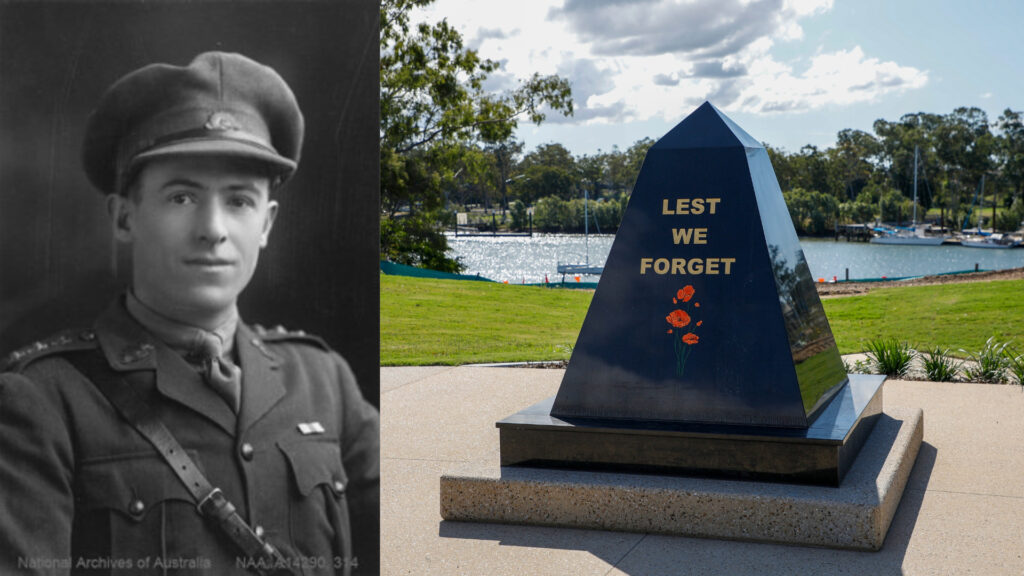
The story of distinguished Bundaberg serviceman Major Charles Wittkopp MC will come to life at ANZAC Park this week.
To mark Remembrance Day the Bundaberg Regional Heritage Group will present a special illuminated display celebrating his service and contribution.
Running on 10, 11 and 12 November from 6.45 pm, the eight-minute presentation will feature historical photographs and storytelling.
Find out the history of Major Wittkopp below, written by BRHG member Jenny Goss:
With an abiding dedication to service and a perhaps inherited dislike of German aggression, Charles was a strong family man, a highly successful businessman and entrepreneur, and a courageous soldier dedicated to service for his country.
Early life
Charles (Carl) August Wittkopp born 12 Feb 1895 in Maryborough – one of four sons and seven daughters of Carl (Karl) Rudolph Wittkopp and Fanny (nee Wasson).
Carl senior was born in Prussia 5 March 1864. He married Fanny (Nee Wasson) on 25 March 1887. He spent most of his life (other than 14 years in Kingaroy) in Maryborough working as a Master Plumber with his residence at John Street Point Lookout Maryborough.
The family story is they were concerned about the possibility of German invasion and decamped to Kingaroy to put some distance from the coast. He died in Maryborough 12 Oct 1927 and his obituary notes he took a ‘keen part in military activities’ and ‘great interest in all branches of sports’. [1]
Somewhat ironically, given Wittkopp Senior fled Prussia to avoid unrest in Germany, Charles had distinguished and honourable career in both World Wars fighting the Germans.
Both Wittkopp boys – William and Charles followed their father’s career and were also plumbers by trade.
War service
However, Charles joined the A.I.F. (Australian Imperial Forces) 9th Division in 17 June 1915 at 20 years of age in Brisbane as a private after spending 6 months with the Australian Light horse in Kingaroy.
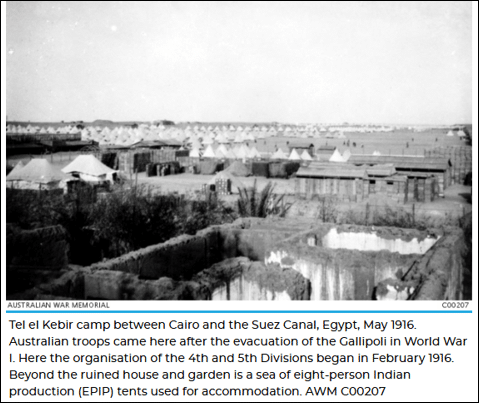
He left Brisbane for the Suez on the 5 October 1915, arriving 8 November 1915. He spent time in the tent camp at Tel El Keber where they received further training and ‘hardening up for combat’.
Tel El Kebir is 110 kms NNE of Cairo. At its height there were some 40,000 Australians camped in a small tent city at Tell El Kebir of six miles in length. [2]
Ultimately, he shipped to Europe and disembarked in Marseilles 3 April 1916. His leadership potential was recognised early on and he was promoted to temporary Sergeant on the 27 February, Sergeant by 17 April, and 2nd Lieutenant on 16 April 2016.
In his initial major battle action, he sustained a gunshot wound to the leg – 23 July 1916[4]- during the first day of the “Battle of Pozieres” which was part of the Battle of the Somme, and was subsequently repatriated to England to recover.
He rejoined his unit in France 9 March 1917, and was promoted again in the field to Lieutenant.
Losses – injuries and deaths – of all allied forces and the Germans had been, and continued to be horrendous.
During a successful counter attack at Lagnicourt [5] (part of the Battle of Bullecourt), he was awarded the Military Cross for “conspicuous gallantry and devotion to duty” and later promoted to Captain 9 September 1917.[6]
It was during a heavy German attack at dawn on 15 April 1917 that he “displayed great gallantry and initiative in leading his platoon on a counter attack. Later he reorganised his company, and collecting all men in his vicinity, advanced on the enemy causing heavy losses”. [7]
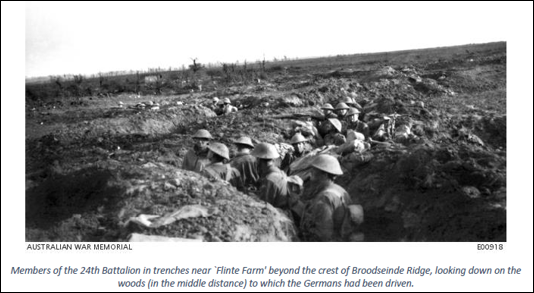
He was severely wounded (again) in Belgium at Broodseinde [8] October 1917 during the 3rd Battle of Ypres or the “Battle of Passchendaele[9]. ”
These injuries – gun shot would to the head, left arm, left leg and shoulder – were deemed so severe he returned to Australia 30 January 1918 and his appointment was terminated 24 April 1918 when he was “struck off strength”.
However, he recovered and rejoined the A.N.&M.E.F. (Australian Naval & Military Expeditionary Force) on 2 June 1918 as 23 year old Captain having spent 2 years and 9 months in the AIF. He all but immediately left Brisbane for Rabaul on 4 June 1918 to serve in PNG until 14 September 1920.
In just over 2 years he served as the censor in Rabaul, and District Officer or Commanding Officer at various garrisons in Kaeweing, Namatanai, Manus, Kokopo and Rabaul. In the middle of which he was seconded to “Native Affairs” for 11 months.
He was clearly committed to service, enlisting again in WW2 with the 47th Infantry Battalion as a Major from 1940-1942 [10] based in Maryborough training soldiers.
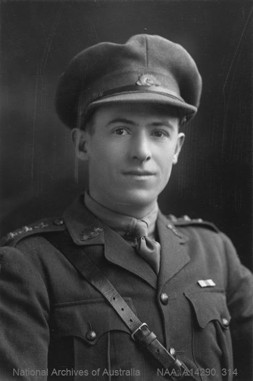
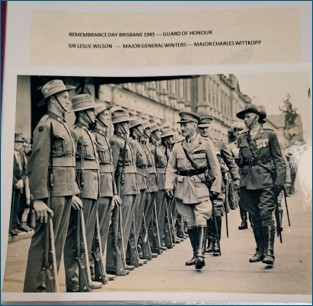
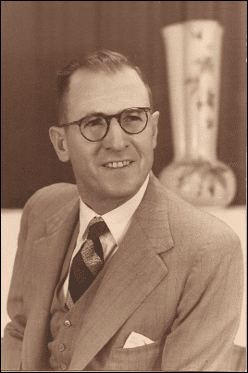
Images supplied by his descendants show a young, fresh-faced Army Captain after his service in WWI and later an older and sterner Major during Remembrance Day on Brisbane during WWII.
Family
On returning to Bundaberg after his First World War service, he married Doris Lilian Murchie 8 June 1927 (daughter of Andrew and Ada Murchie) in a quiet celebration at the Presbyterian Manse in Bundaberg [11].
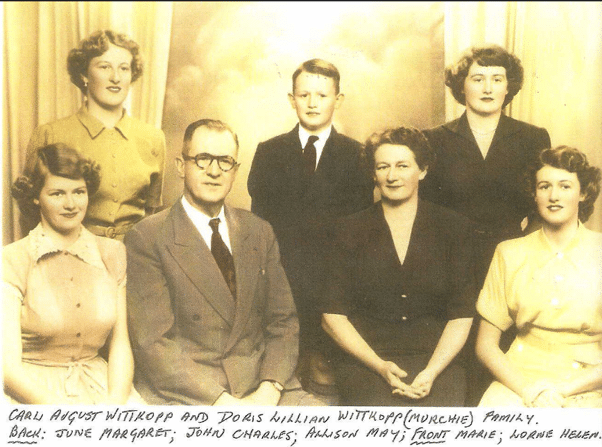
Their first born child was a daughter – Marie; followed Allison May in 1929, June Margaret in 1931, Lorne Helen in 1933, John Charles in 1941; then Barbara Ann in 1945 who sadly died in 1948.
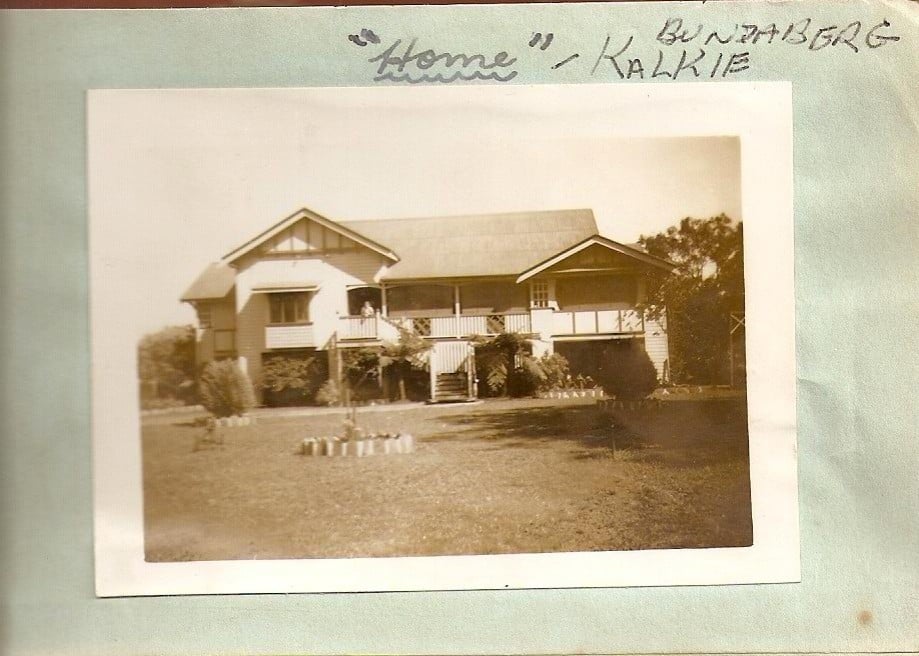
Initially living in McIlwraith Street, they moved to 167 Bargara Road Kalkie (then Sandhills Road) in February 1939.
Business
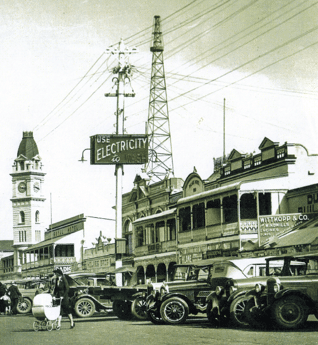
Between the wars Charles established Wittkopp & Co (Plumbers and plumbing supplies) which initially traded from Targo Street.
However, he expanded the business into hardware and ‘general utility’ in June 1933 relocating to Bourbong Street.
“The courage and enterprise of the company in launching out in a new direction should meet with a full measure of public patronage.” [12]
“It speaks volumes for the cheerful optimism of the company that in the face of so-called depressing times they have added a new section to their already large business connection.” [13]
The business traded successfully for more than 40 years, moving to Woongarra Street as a Mitre 10 store in 1965.
He also bought Gayndah Motors in the 1950s and it remained in the family name until it was sold in 1983.
Community
Charles was a committed to his community and was heavily involved in Rotary.
Throughout his lifetime he was also a strong advocate for returned servicemen and women and was a president of the Bundaberg RSL sub-branch. [14]
He died in Brisbane 12 July 1956 where he was receiving treatment for cancer.
His funeral in Bundaberg on 14 July was extremely well attended and included a full military guard of honour at the Church of Christ and at the cemetery.
It must have truly been absolute field of wreaths according to the Newsmail report at the time.[15]
He was survived by wife Doris and his children. Many of his descendants still live in Bundaberg and we are grateful to them all and particularly Jan Cumerford for permission to use the images contained in this story.
Lest we forget
Whilst he has been included in the Bundaberg “Hall of Fame” and the “100 Years of Anzac” in 2014 (both publications of the Newsmail) this is a man whose service for his country and his important contributions to Bundaberg’s business and community cannot be overstated.
- Son of a Prussian plumber and himself a plumber by trade;
- Served in both wars, wounded twice, awarded the Military Cross, promoted in the field 4 times;
- Founder of a ‘hardware store’ in the 1930s which traded successfully through the Depression and for over 40 years;
- Devoted husband to Doris and Father to June, John, Allison, Marie & Lorne;
- Remained heavily involved in Rotary and the RSL and was a strong advocate for returned servicemen and women until his death at 61.
Speak his name and remember him well.
Thank you, Charles (Carl August) Wittkopp.

References:
[1] The Colonist 22 Oct 1927 Pg 19
[2] https://en.wikipedia.org/wiki/Tell_El_Kebir
[3] https://anzacportal.dva.gov.au/wars-and-missions/ww1/military-organisation/training
[4] https://en.wikipedia.org/wiki/Battle_of_Pozi%C3%A8res
[6] https://www.awm.gov.au/collection/E84326
[7] https://recordsearch.naa.gov.au/SearchNRetrieve/Interface/ViewImage.aspx?B=7017156
[9] https://en.wikipedia.org/wiki/Battle_of_Passchendaele
[10] https://www.anzacsquare.qld.gov.au/memorials/47th-australian-infantry-battalion-wwii
[11] Maryborough Chronicle 13 Jun 1927 Pg 8
[12] Bundaberg Daily News & Mail 2 Jun 1933 Pg 3
[13] Bundaberg Daily News & Mail 2 Jun 1933 Pg 3
[14] Bundaberg Newsmail 100 Years of Anzacs Special Nov 2014 Page 18
[15] Bundaberg Newsmail 14 July 1956 Page 3.