


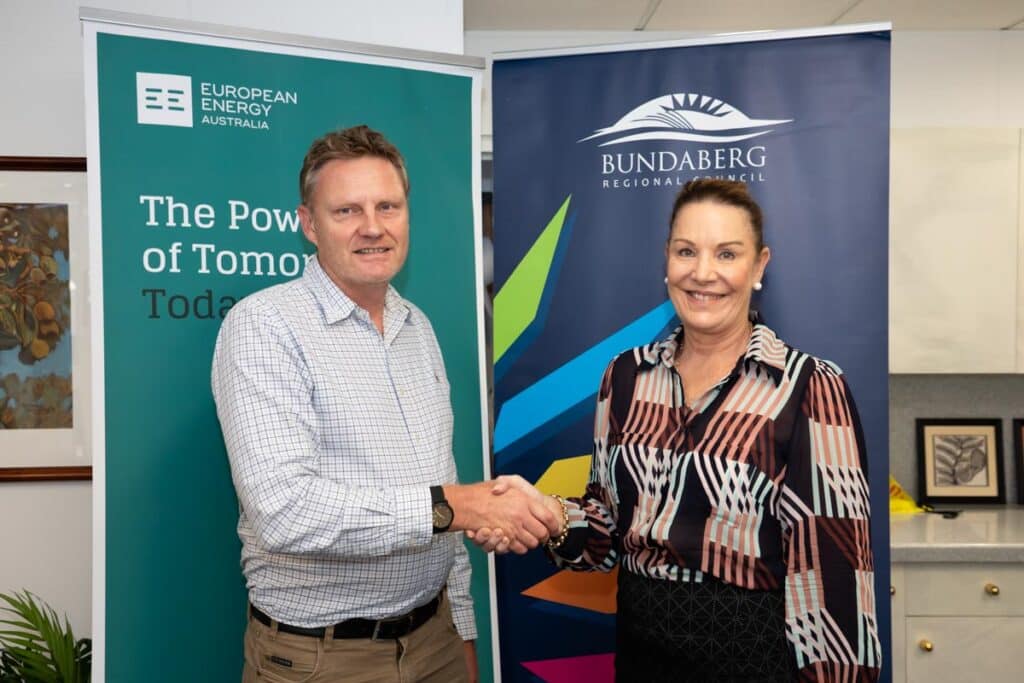
The region’s first Community Benefit Agreement (CBA) for a renewable energy project will, if the project is approved and constructed, deliver significant annual benefits in grants for local groups and regional projects.
The terms of the CBA, approved at Council’s Ordinary Meeting on Tuesday 27 October, require European Energy Australia (EEA) to provide $82,450 annually for the life of their Bullyard battery and solar project.
The agreement between Bundaberg Regional Council and EEA was a requirement within the Battery Energy Storage System (BESS) development application which is assessed through the State Government.
The proposal would see the battery facility sit alongside the company’s solar facility which was approved before legislation changes required the developer to establish a CBA with Council.
However, in a win for the local community, EEA and Council have agreed that the contributions under the CBA will be calculated on the full project, reflecting the overall scale and community impact of the project.
European Energy Australia Head of Stakeholder Relations Kerrie Jocumsen said they were happy to support the region’s locals.
“European Energy Australia is pleased to contribute to the values, priorities and aspirations of the local community through long-term community benefits,” Kerrie said.
“This Community Benefits Agreement is our shared mechanism with the Bundaberg Regional Council to do that, and we look forward to delivering for the community.”
Bundaberg Regional Council Mayor Helen Blackburn said the agreement was designed to ensure the community closest to the renewable energy project were the primary beneficiaries.
“If the project is approved by the State Government, during the operational life of the facility the benefits will be delivered through a range of small grants and sponsorships, strategic projects and a future fund,” Mayor Blackburn said.
“Up to 40% of the annual contributions will be made available for grant applications between $1,000 to $5,000 to support local community groups, small businesses, events, clubs, schools and not-for-profits.
“The grants awarded under this part of the program will be determined by a Community Reference Group.
“The strategic project funding, also 40% of the contributions, will deliver large multi-year, region-wide projects determined by the Steering Committee and informed by feedback from the Community Reference Group.
“Applying this process will ensure the local community is directing the funds to where they have determined they need it most.”
Up to 20% of the total annual contribution can be used for contingency and pooled for future legacy projects.
Additional measures
As part of its Social Impact Assessment, EEA has identified additional measures which would be addressed during the construction period.
These include undertaking direct neighbour, community and stakeholder engagement, a traffic management plan and impact assessment and local content plans for workforce and procurement.
“We’re really excited about continuing to work with the Bundaberg Regional Council and the business, education and employment organisations we’ve been engaging with over the past year, to get the most out of our project for the local community,” Kerrie said.
How the benefits are calculated
The benefit contributions are calculated based on the energy production capacity of the renewable energy facility and using the formula in Council’s Renewable Energy Community Benefit Agreement Policy.
The annual community benefit contribution for the BESS calculated under Council’s policy is $71,550 per year.
This is based on Council’s understanding that the proposed BESS will have a capacity of 270MWh (i.e. $265/MWh x 270MWh).
EEA has committed to an additional voluntary financial contribution of $10,900 for the solar facility which will have a capacity of 97MW.
The total community benefit contributions are $82,450 each year that the battery facility is under construction or operational.
EAA has also made a one-off payment of $40,000 to contribute to Council’s costs in developing the agreement as required under Council’s policy.
The policy also requires an administration contribution of 5%, or $4,123, on top of the CBA, payable on commencement of construction for the facility and then annually for the life of the development.