

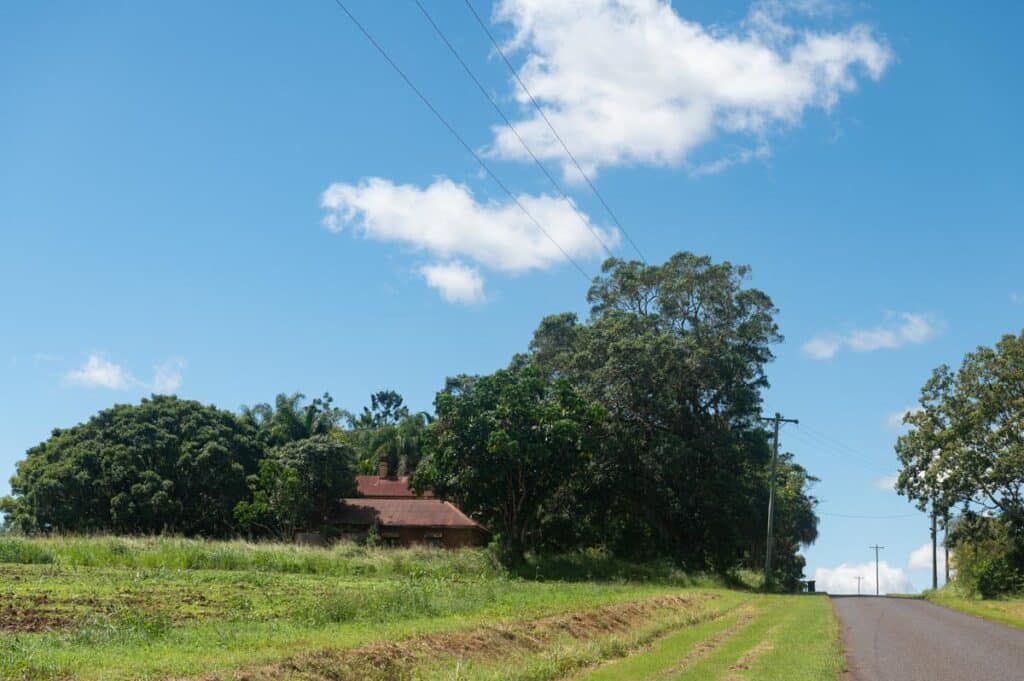
On the outskirts of Childers, Adie’s House and site endures as an ongoing legacy of one of the Isis District’s most prominent sugar industry figures, Alexander Adie.
Located on private property, the site retains a substantial home, a low set brick building that was the former staff dining room and kitchen and the remnants of other structures.
The house and site are listed on Bundaberg Regional Council’s Register of Local Heritage Places as important representations of a rare and endangered aspect of the region’s history.
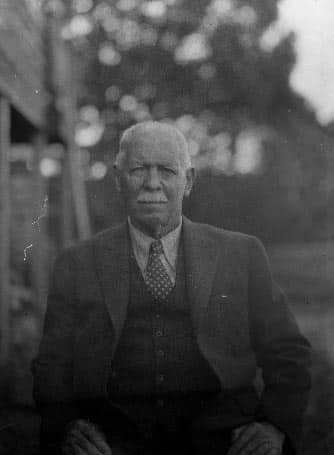
Alexander Adie
Alexander Adie was born in Aberdeen, Scotland in 1861 and emigrated to Queensland in 1881.
He moved to the Isis district in the 1890s, where he began to grow sugar cane, working first on Duncraggan Plantation before purchasing a property of his own.
The Isis district became an important area for sugar cane farming and refining from the 1880s and Alexander was a significant supplier of cane in the district.
He began supplying sugar cane to Alexander Christie Walker, who established the Knockroe Sugar Mill in 1893.
He continued to expand his cane plantation and supplied other mills, including the Isis Central Sugar Mill when it commenced crushing in September 1897.
Alexander became one of the directors of the Isis Central Sugar Mill in 1906, and then in 1915 was appointed Chairman of Directors, a position he held until his death in 1940 aged 79.
During the early 20th Century, smaller mills across the Isis closed down, with the last competitor, CSR’s Childers Mill, closing in 1933, leaving Isis Central Sugar Mill as the only mill remaining.
Alexander is recognised as one of the key figures in the mill’s management that engineered its domination of the Isis district.
Vast cane plantation
The property was located adjacent to the Isis Central Sugar Mill and near Cordalba, and by the 1920s consisted of 800 acres, about 500 acres of which was planted with cane.

Alexander also operated a butchery business, supplied with cattle from two cattle stations he owned, Agnes Vale and Bucca.
The plantation employed South Sea Islander and European workers, at least up until deportation of South Sea Islander workers following the passage of the Pacific Island Labourers Act 1901 by the newly-established Federal parliament.
By the late 1920s, Alexander employed between 40-50 permanent hands, most of whom were accommodated on the Isis property.
Single hands were quartered in barracks and married hands in their own individual cottages.
There was a dining room and cook’s quarters, and a recreation reserve that included a tennis court.
Public Life
Alexander Adie also became a significant public figure in the Isis district, serving as councillor for the Isis Shire from 1910, and Chairman of the Isis Shire Council five times between 1911-3, 1918 and 1930-40.
He was the first representative of the Isis District on the Queensland Cane Growers Council.
Alexander became Chairman of the Isis District Hospital Board in 1932 and, according to newspaper reports, was still active on the board at the time of his death.
He was married to Ellen Alexander (nee Lamb) of a pioneering Isis family, and together they had four children, George, Nell, John and William.
After Alexander’s death, Isis Central Sugar Mill paid tribute to his longstanding loyalty and contribution to the mill’s success by erecting modern new offices named in his honour.
Current site
Adie’s House and site are located in slightly sloping terrain approximately 2 km west of Isis Central, set among cane fields and bounded by Adies Road in the south.
The house occupies a one acre block to the east of the site and is set in mature gardens, separated from the road by a post and wire mesh fence with a picket fence gate covered by a trellis.
The high set timber residence on timber stumps has a truncated pyramid corrugated iron clad roof.
A wraparound verandah, covered by a separate roof supported by timber posts with decorative brackets, features a dowelled balustrade with decorative panels.
The main entrance of the home faces Adies Road, with bifurcating timber stairs leading to a landing covered by a gable supported by timber posts and decorated with fretwork and a finial.
A sign reading ‘ADIES • 1902’ is suspended from the gable.
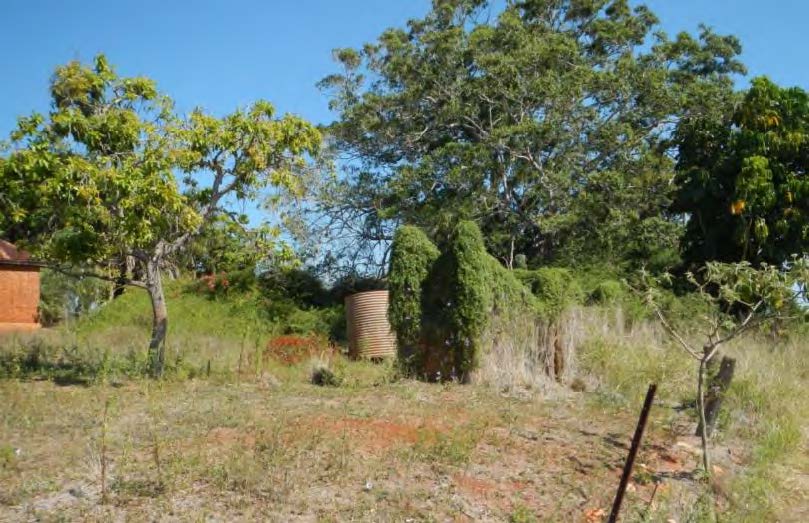
Located in the partially cleared area west of the residence are the former dining room and kitchen, consisting of a low set brick building with hipped corrugated iron clad roof.
An unrendered Colonial style brick chimney with corbel and double arched brick cowl and two corrugated iron watertanks on brick tank stands are found on the western side.
An earlier study identified remains of the butcher shop and stables on the site.
Heritage significance
Adie’s House and site is important in demonstrating the pattern of the region’s history.
The size and scale of the operation was significant relative to other farms, particularly in combination with the butchery operation.
The surviving masonry structure adjacent to the house and other material remains of facilities constructed for Alexander’s employees, represent rare and endangered aspects of the region’s history, as surviving structures and material evidence of these activities are no longer common.
Adie’s House and site are private property and not accessible to the public.

This story is shared as part of Bundaberg Regional Council’s Australian Heritage Festival celebrations.