


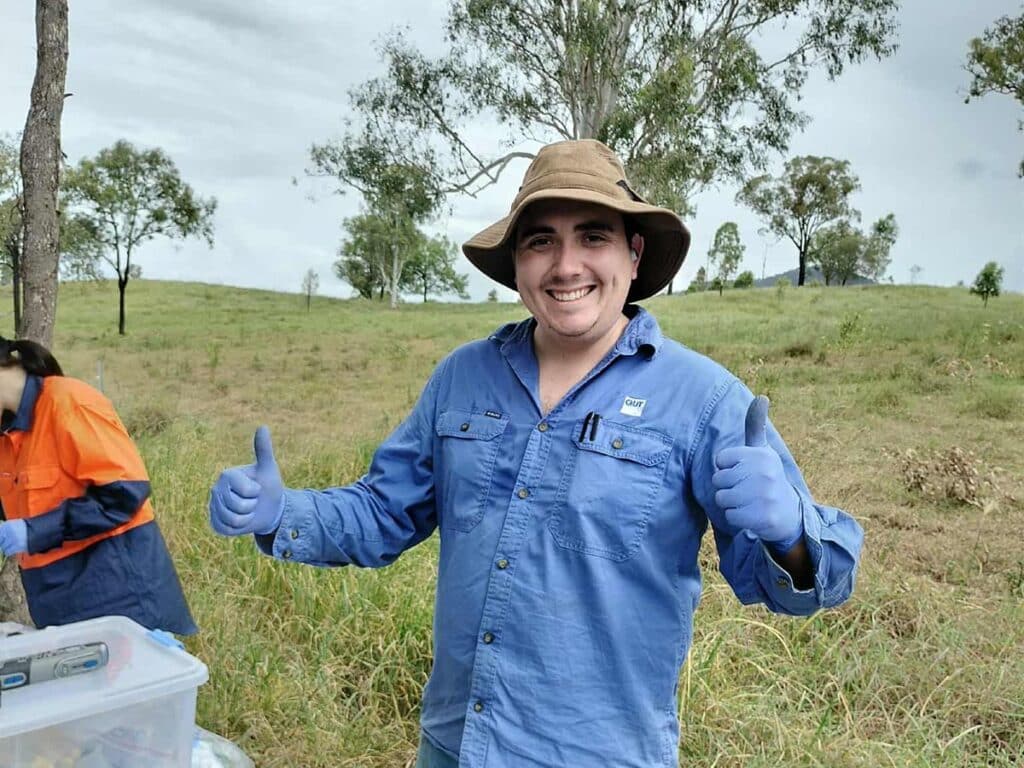
Bundaberg-raised PhD student Edward Bryans is part of a team researching ways to combat the costly problem of mealybugs, a tiny insect killing millions of hectares of pastures across Queensland and New South Wales.
The project has been supported as part of a Memorandum of Understanding (MOU) between Bundaberg Regional Council and Queensland University of Technology (QUT) to undertake education and research activities on matters of agriculture and energy in the Bundaberg Region.
Through the MOU scholarship, Edward’s research is focussed on enhancing natural biological controls for mealybug, found in sorghum and sugar cane in the Wide Bay area, by improving pasture management.
He is particularly interested in the beneficial effects of including legumes in pasture mixtures, which may help graziers to fight the pest by
- providing livestock with a source of food when the grass dies
- boosting beneficial soil fungi that protect the grass from pasture dieback
- providing shelter and food to parasitoid wasps.
QUT Pro Vice-Chancellor (Entrepreneurship) Professor Rowena Barrett said Edward’s research into parasitoid wasps was especially exciting.
“Parasitoid wasps have been used worldwide to control outbreaks of mealybugs and Edward is identifying new Australian parasitoid wasps,” Professor Barrett said.
“He has identified four new parasitoid wasps that attack the pasture mealybug, and one of these is a new, and as yet undescribed species, which is adapting to kill the pest.
“With the discovery of these new parasitoid wasps, researchers hope they will increase and provide permanent reductions in mealybug pest numbers.
“Edward’s research is contributing to practical, cost-effective and, hopefully, long term solutions to the control of mealybug across the Wide Bay and Central Queensland.”
Bundaberg Region Mayor Helen Blackburn said it was encouraging to see that research undertaken through the MOU with QUT was already showing promise.
“The Bundaberg Region is known for being enterprising and forward-thinking, from one of our original innovators, Bert Hinkler, through to local leaders paving the way in manufacturing and agricultural technology,” Mayor Blackburn said.
“By supporting students to invest their time and intellect in challenges that affect our region, we can help drive the development of a thriving regional economy.”
Edward recently articulated his Master’s degree into a PhD to continue his work on the relationship between legumes, soil microorganisms, beneficial wasps and the pasture mealybug.
His research is being conducted on trial plots established by Dr Naomi Diplock of the Bundaberg based Applied Horticultural Research (AHR), with funding from Meat and Livestock Australia (MLA).